Rational method
Peak discharge of a small catchment from its runoff coefficient, the rainfall intensity and its area, with the frequency factor for rarer storms.

Hydrology Pro works out how much of a storm runs off a catchment, how fast it gathers and how high it peaks, with the chart and a PDF report to go with it. For iPhone and iPad.
Coming soon to the App Store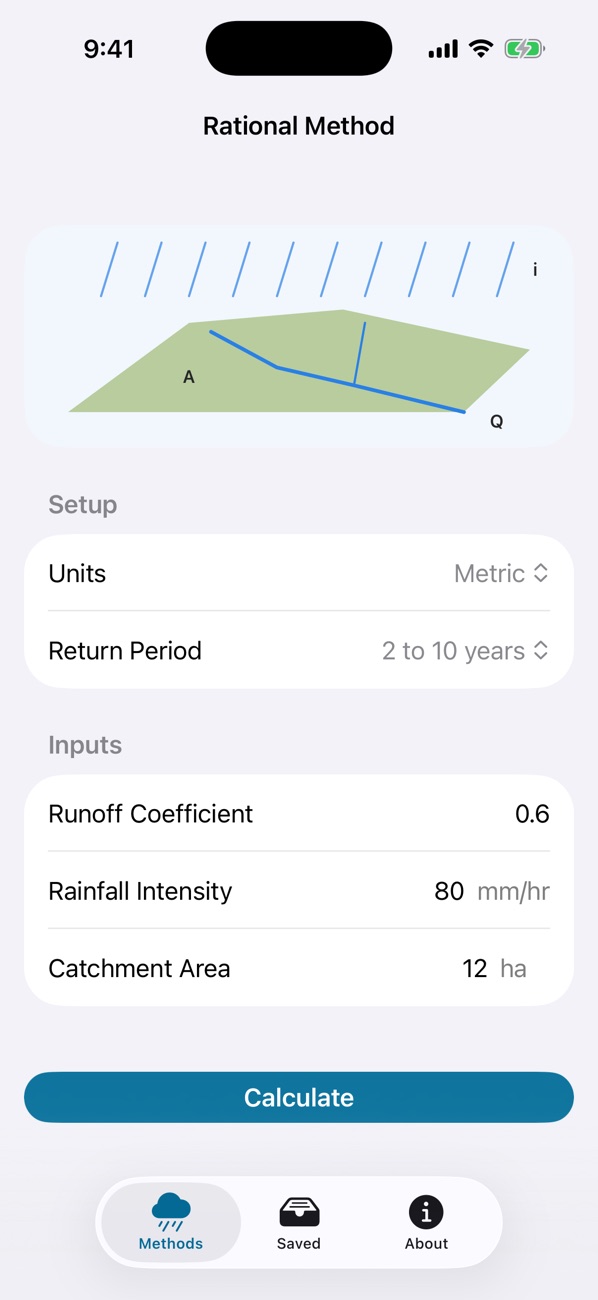
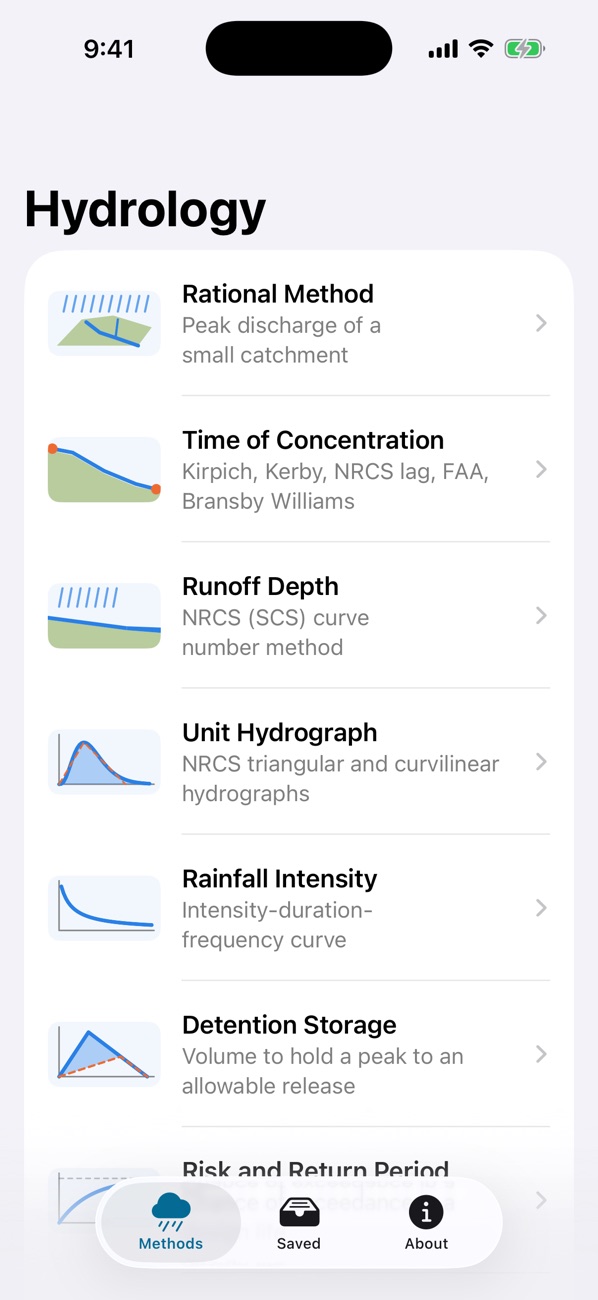
The everyday calculations of drainage and flood design, each with a note on what it was derived for.
Peak discharge of a small catchment from its runoff coefficient, the rainfall intensity and its area, with the frequency factor for rarer storms.
Kirpich, Kerby, the NRCS lag equation, the FAA equation and Bransby Williams, to suit overland flow, small channels or larger rural catchments.
The NRCS (SCS) curve number method: runoff depth and volume, the retention and the initial abstraction.
The NRCS triangular and curvilinear hydrographs: peak discharge, time to peak, and a table of ordinates.
An intensity-duration-frequency curve with your coefficients, with the intensity and depth at standard durations.
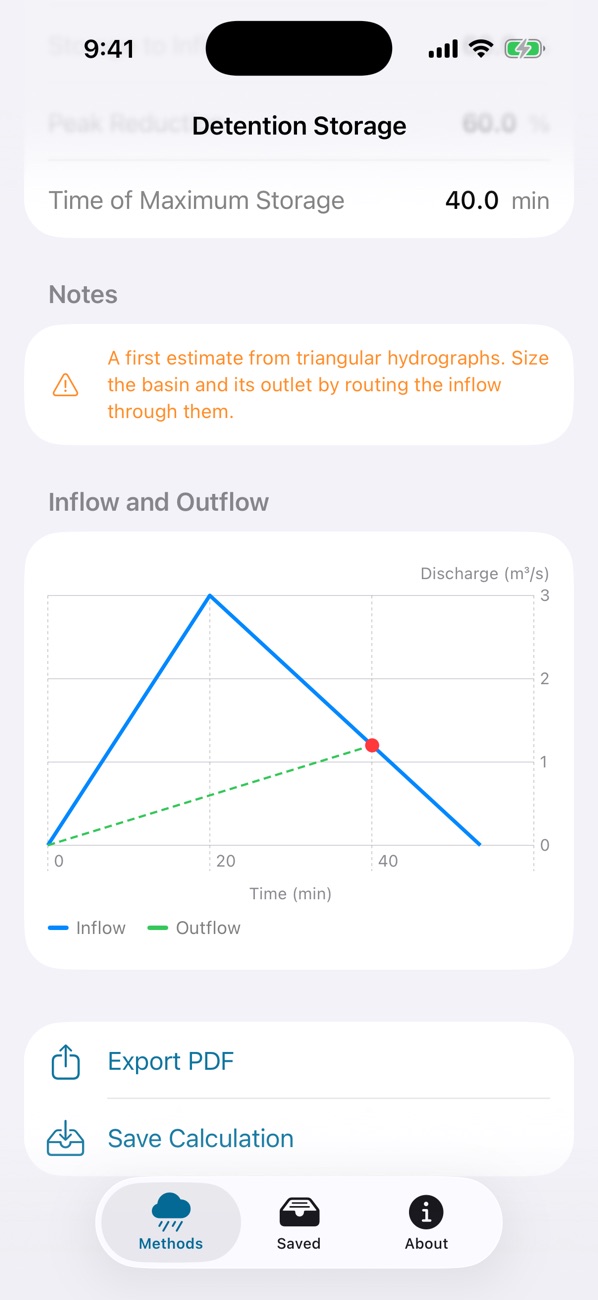
A first estimate of the volume that holds an inflow peak back to an allowable release.
The chance that a design event is exceeded in a design life, or the return period to design for at a risk you accept.
The Gumbel distribution of annual maxima: the design value at any return period, with a table of standard ones.
The results are for preliminary design and checking. Coefficients and curve numbers depend on the catchment: confirm them from local data and standards, and have the design reviewed by a qualified engineer.